


Paicega and Argul: two places to discover Asturias’s past
The medieval village of Argul and the settlement of A Paicega are two of the gems awaiting you in the municipality of Pesoz, in western Asturias. It is undoubtedly a fascinating journey into the past.
The municipality of Pesoz is one of the smallest in the Principality of Asturias; however, it is home to some real gems of our heritage that you really must discover. In this article, I suggest two easy routes through this rugged landscape in south-western Asturias, which you can follow on foot, by bike or in your own car, taking you to the medieval hamlet of Argul and the abandoned settlement of A Paicega. A real journey back in time!
Pesoz, the council’s administrative centre – The starting point
The parish of Pesoz is the only one in the municipality and also its administrative centre. Vines are cultivated in this rugged area of western Asturias. Wine-growing is also practised in other neighbouring municipalities that enjoy the same distinctive microclimate, and which even have their own designation of origin, the D.O.P. Cangas.
Other highlights in Pesoz include the Romanesque Church of Santiago and the Palacio de Ron, built in the 17th century for Álvaro Díaz, a descendant of a powerful and highly respected family in the lands nourished by the rivers Eo and Navia. From this stately home, you can set off on the routes I suggest below.
Discover the medieval village of Argul

Although there is evidence that the Albiones (an Asturian-Galician people) settled in the Alto Navia mountain range and that the Romans of the ‘Conventus Lucensis’ dominated the territory to control gold extraction from open-cast mines, Argul does not appear in historical records until 30 May 972. The families of Argul have always made their living from agriculture and livestock farming, particularly the cultivation of vines and cereals. Throughout the Middle Ages, they built a total of 30 farmhouses perfectly adapted to the complex terrain.

Argul grew up on a natural rocky outcrop, which shaped the way its houses were built. The rock enabled the inhabitants to construct large, spacious houses without the need for foundations or thick walls. However, the steepness of the hillside forced them to create a series of passageways and tunnels to connect the different rooms within the houses.

The farmsteads of Argul were organised around a central courtyard where dovecotes and granaries were situated, built entirely from local materials (slate, wood and clay). Livestock were herded through the ‘veiriles’ (tunnels), and the corridors were used to move from one room to another without having to go outside.
Famous in Argul is the Casa de Vilar, which has a tunnel almost 20 metres long, and the Casa de Juan Alonso Villabrille y Ron, a sculptor at the court of Philip V. Also of note is the Chapel of San Antonio, built on the rocky outcrop and featuring a curious Baroque altarpiece adapted to the limited interior space.

The architecture of Argul is among the most distinctive in the Principality of Asturias, which is why its historic centre was designated a Site of Cultural Interest in 2004.

From Pesoz to Argul along the Agüeira River Route
The medieval village of Argul is five kilometres from the council capital. You can get there in your own car or by taking a pleasant walk. If you choose the latter option, you’ll follow the Agüeira River Route, signposted as a short-distance trail (PR. AS-117) and 10 kilometres long. This route, which is clearly signposted, presents no difficulty and is suitable for mountain biking. The path runs through the woods, so the surface is uneven and, in some sections, quite steep. You’ll also walk on tarmac; however, as it’s in a remote area, there’s practically no traffic.
If you leave your car next to the Palacio de Ron, you’ll find the start of the Agüeira River route just past the pilgrims’ hostel. This first section, which is a continuous descent, leads into the riverside woodland until it reaches the river. Following the signposts, you should cross to the other bank and head uphill through a beautiful chestnut grove. You then descend to the Molín de Sequeiros, where there is a small area perfect for a rest and, weather permitting, a swim. From here, the path climbs steadily until it reaches the access road to Argul. The return journey follows the road until you come to a turn-off on the right which will take you directly to Pesoz via a steep slope.
To Paicega, the ruins of a workers’ settlement overlooking the Navia River gorge
Many tourists travel to south-western Asturias, drawn by the incredible scenery of the Navia Valley. A key highlight of the route is the Salime Waterfall, one of the most spectacular in the region. The Grandas de Salime reservoir is the largest in Asturias, and its dam was once the largest in Europe. This colossal project, completed in 1955, was built in just a decade.
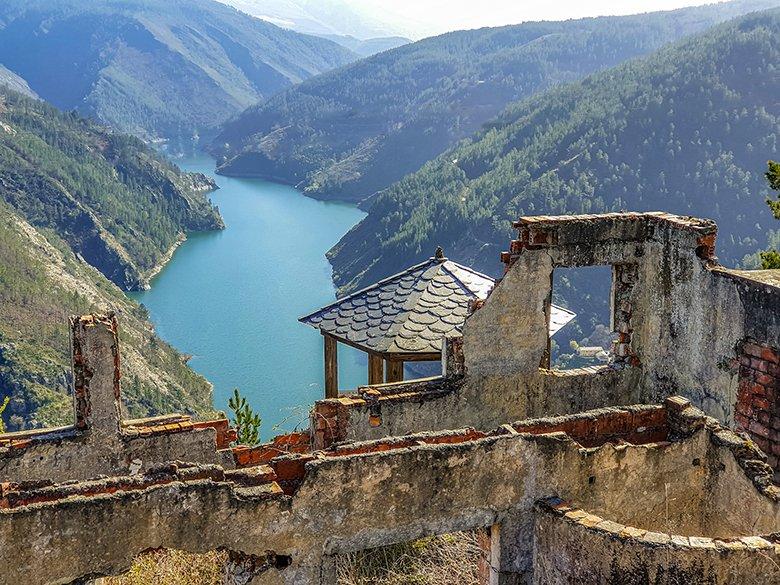
In order to carry out the project, it was necessary to build several settlements to house more than 3,000 workers who had arrived from all over Spain. They also built a 40-kilometre cableway linking El Espín – Coaña – with the main camp. This system enabled them to transport materials without having to rely on the winding – and precarious – road links.

The most important settlement was A Paicega, home to many families for 10 years. Among other facilities, it had housing, a school, a canteen and a hairdresser’s.
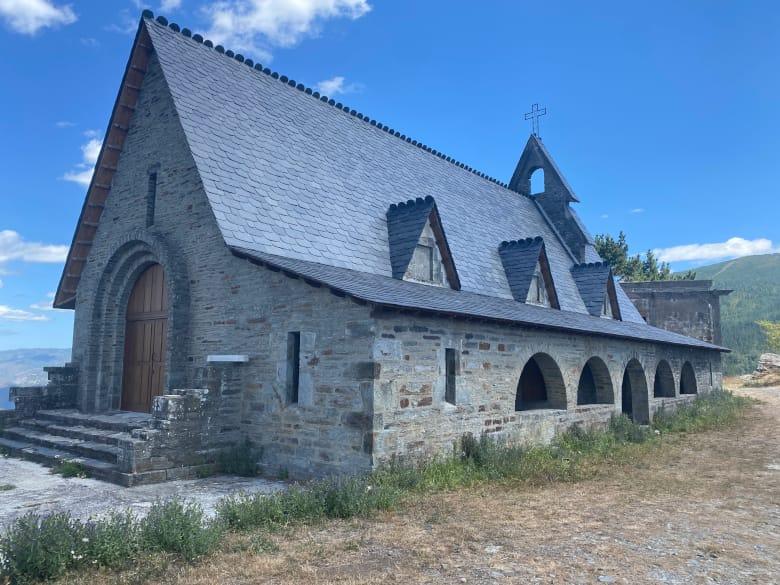
When the building work was completed, the workers left the settlements. All that remains today are the foundations of the houses, with the occasional remnant of a tile, a window or a washbasin. Only the Church of A Paicega has remained unchanged since it was consecrated in 1948 to Our Lady of La Luz. Thanks to a local initiative, it is being restored to serve as a cultural centre.

Also worth mentioning is the A Paicega viewpoint, situated in the lower part of the village and offering spectacular views of the Navia River gorge.

From Pesoz to A Paicega through a fairytale forest
The second route I suggest starts at the Pesoz fountain, situated opposite the Palacio de Ron. The uphill path between the houses soon turns into a track that winds through a native woodland of chestnut and oak trees. Although you gain altitude, it is a gradual climb that is very easy to manage. You’ll then reach a forest track where you should turn right. This will take you to the village of Sanzo. Cross the village and follow the dirt track; it will take you to the hamlet of A Paicega. To return, you can retrace your steps or head back along the road. This route is signposted as the short PR AS-169 trail and is 8 kilometres long (there and back). This route is also suitable for mountain bikes.
Final tips
If you want to complete both walking routes in a weekend, you can stay overnight in Pesoz. The village has several rural guesthouses and a restaurant, where you can sample traditional Asturian cuisine.
Argul is a hamlet where a few families still live. Although it may appear deserted due to the dilapidated state of most of the farmhouses, it is a living village. Please be considerate of the residents and, of course, ask for permission before entering their property.
Whilst you’re exploring the village of the workers who built El Salto de Salime, do pop into the Saltos del Navia Hydroelectric Power Station. A one-hour guided – and free – tour will give you a deeper insight into this gem of Asturian industrial heritage.
And whilst you’re in Pesoz, just 7 km away is the Grandas de Salime Ethnographic Museum “Pepe el Ferreiro”, a highly recommended visit in the area.
Subscribe to our newsletter and take advantage of offers, discounts, and news
Subscribe


