


The 10 most interesting things to see and do in Luarca and the surrounding area
Luarca and the whole municipality of Valdés offer a variety of cultural and tourist attractions that are sure to captivate you. That’s why we’ve put together a list of the 10 best things to see and do in Luarca and the surrounding area!
The municipality of Valdés covers a vast territory, whose immensity is complemented by a tapestry of contrasts and attractions in a world of vaqueiros, carved out amongst mountains, valleys and high mountain pastures that seem to yearn to embrace the sea, which laps just a few kilometres away
And Luarca/Ḷḷuarca, its capital, is a peaceful fishing town, which has been an important fishing port since the Middle Ages and retains many traces of that glorious past: historic neighbourhoods, the remains of a fortress, the Mesa de Mareantes y Navegantes, legendary bridges, and palaces and houses bearing coats of arms. As if that were not enough, it was the birthplace of the Nobel Laureate in Medicine, Severo Ochoa, and still preserves many memories of him.
Luarca/Ḷḷuarca is so white that it hardly seems to belong to the Atlantic coast. Furthermore, it is the only town in the whole of Asturias flanked by two viewpoints and two chapels: the white one to the east and the Chapel of San Roque to the west, and it boasts the most beautiful cemetery in the entire Cantabrian region.
Of course, the surroundings of the ‘White Town’ are an inexhaustible source of delightful discoveries: one of the largest and most exotic botanical gardens in the whole of Europe; a park halfway between Earth and the Cosmos; a headland where the finest winds blow and Spain’s finest cakes are baked; an Asturian pilgrimage at the foot of a cliff; or the most beautiful beaches where you can enjoy unique landscapes, idyllic swims or incredible waves.
Cabo Busto: wind and gentleness
Between sun and clouds, wind and calm, Cabo Busto stands ever majestic. Indeed, this headland is, alongside Peñes and Vidio, one of the most prominent and striking points along the entire Asturian coast.
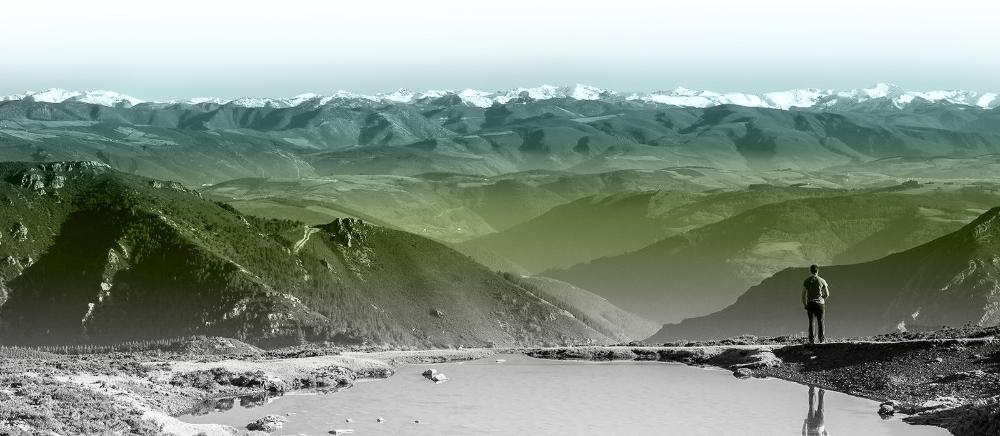
Cabo Busto is one of the most impressive vantage points on the western coastline. The area around the lighthouse is a vast plain from which, in a sweeping panoramic view, you can take in the height of the brañas vaqueiras and the grandeur of the Cantabrian Sea.
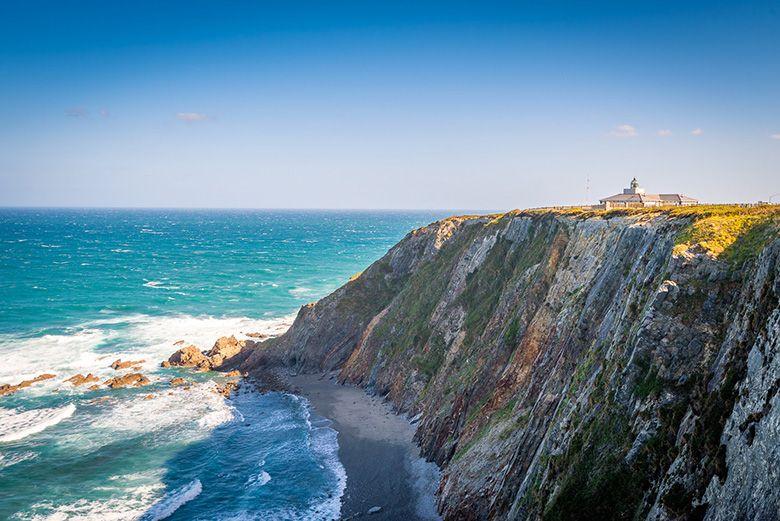
One of the best ways to enjoy and explore the habitat of Cabo Busto is to follow the circular route along the path in the area, where you’ll come across viewing points from which you can see the coastline, as well as cliffs, beaches and coves, which together form a rocky symphony of great beauty.
If you look out from here on clear days, you can see the Ermita de la Blanca chapel and the lighthouse in the town of Luarca/Ḷḷuarca, whose presence can be faintly sensed amidst the murmur of the cliffs. And of course, the sunsets are so peaceful that they become pure poetry...

Of course, you can’t leave this place without first taking a stroll through the village of Bustu, which has some delightful spots that showcase the typical architecture of western Asturias, with its stone houses and those distinctive black slate roofs, which can also be seen on the hórreos.
And amongst these delightful spots, there is one that is literally delightful: the bakery and charming shop of Confitería Cabo Busto, considered by food critics to be one of the best in Spain, and run by Jonathan González, who has returned to his hometown to draw inspiration from the scents of his beloved Cabo Busto.
The La Regalina chapel and the most scenic pilgrimage
One of the most beautiful villages in the municipality of Valdés is Cadavéu. It is well known for its ‘Indiana’ architecture and its many hórreos. But what really makes it unique is the La Regalina chapel – which also has two hórreos situated nearby.
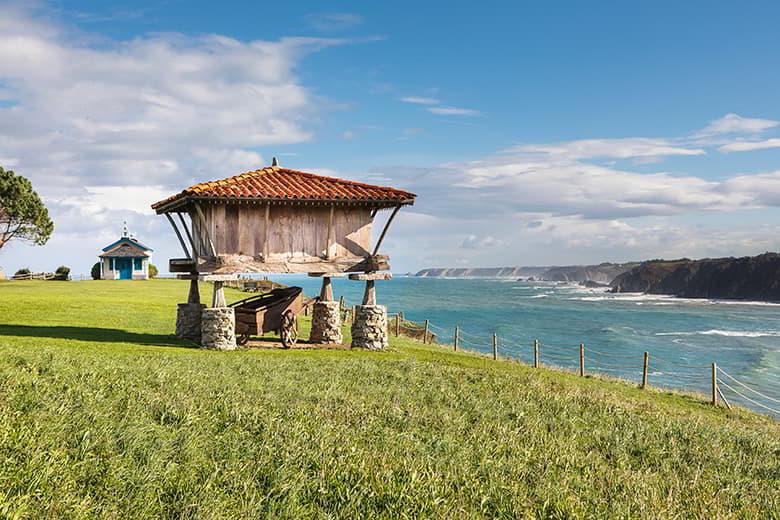
La Regalina, situated in a spectacular spot by the sea, is one of the ‘iconic’ sites on the western coast of Asturias. Thousands of travellers, pilgrims, walkers, writers, artists, filmmakers and others have been captivated by this place, which has a fascinating history, halfway between reality and legend.
It turns out that the Virgin of Nuestra Señora de Riégala – popularly known as La Regalina – is the patron saint of Cadavéu. A popular legend has it that the image was found by a peasant inside the hollow trunk of a chestnut tree, situated near the Riégala spring.
And so, in 1931, the chapel of Santa María de Riégala was built, and that very same year, on the initiative of Father Galo – a key figure in Asturian literature – the Regalina festivities began to be held in the Campo de la Garita, opposite the chapel. Every last Sunday in August, thousands of people take part in an open-air mass, accompanied by a procession of pilgrims dressed in traditional costume, moving to the rhythm of local carts and the music of bagpipes and drums. Never before has a traditional Asturian festival been held from such a privileged vantage point overlooking the Cantabrian Sea.
La Regalina – both the place and the festival – is truly something unique and one-of-a-kind.
The neighbourhood of El Cambaral and the most beautiful lighthouse in the world
Luarca/Ḷḷuarca forms a sort of white amphitheatre, giving it an almost heavenly air, even though it is one of the seaside towns with the longest-standing port and fishing traditions in the entire Cantabrian region.
On one side of this amphitheatre, the neighbourhood of El Cambaral has grown since the Middle Ages; it is one of the original settlements of Luarca/Ḷḷuarca, and which to this day retains that legendary flavour that speaks of a world of pirates and a place where crabs were plentiful.
A stroll through the narrow, winding alleyways of this Luarca neighbourhood is a true immersion in maritime life, reaching its climax at the highest point, when the Mesa de Mareantes y Navegantes comes into view, the cemetery or the Chapel of La Blanca, also known as the Chapel of La Atalaya or the Chapel of the Good Jesus of Nazareth.

The Sailors’ and Seafarers’ Memorial is a site established in memory of the sailors and seafarers of yesteryear who made Luarca/Ḷḷuarca an important port and a thriving town, and was built in the mid-20th century, making use of the remains of an ancient fortress dating from the 16th century. The colourful ceramic tile that adorns the centre of the table, depicting figures from the seafarers’ guild, is a real gem, as is the series of ceramic panels that recount the history of Luarca/Ḷḷuarca.

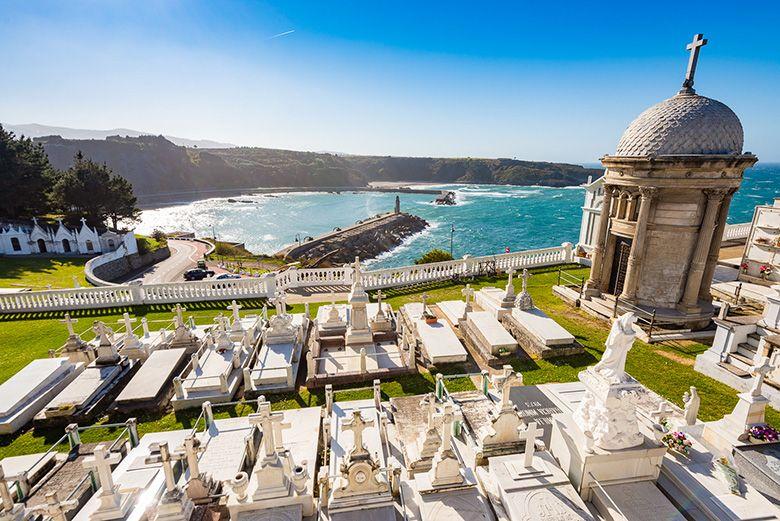
Once you’ve stopped off at La Mesa, your next destination will be the lighthouse and the La Blanca chapel, which form a harmonious and panoramic ensemble from which you can admire the town’s famous cemetery – so white and immaculate, and facing the coast, that it is strikingly beautiful.
7 bridges and a legend
The River Negro flows right through the very heart of the town, spanning seven bridges which lend Luarca/Ḷḷuarca an air of pure romanticism from centuries past.
One of the most beautiful bridges, situated near La Pescadería – the fishermen’s quarter that sprang up on the western slope of the ‘white town’ – is associated with a deeply moving legend.

The story of the Puente del Beso blends epic and literary elements, echoing the most authentic poetry of the sea: popular legend has it that during the Middle Ages the sea was ravaged by fearsome pirates. One of the most famous pirates of the era was the legendary Cambaral, known for his skill in raiding and his iron fist when it came to torture. One fine day, the governor of Luarca/Ḷḷuarca seriously wounded Cambaral. It was then that the governor’s daughter asked her father to let her tend to the wounded pirate in the palace. And it so happened that Cambaral fell madly in love with the beautiful young woman, who in turn also fell for the privateer. They decided to flee together, and whilst meeting to plan their escape, they shared a passionate kiss. They were unexpectedly caught by the governor, who, in a rage, beheaded them with his sword. Their bodies remained entwined and their heads rolled out to sea… That is why they say that on nights when the moon shines, in Luarca/Ḷḷuarca, words of love can be heard coming from the sea…
The village where a Nobel Laureate in Medicine was born
Quite literally, Luarca/Ḷḷuarca is a Nobel town; its streets and squares, its promenades, its watchtowers, its neighbourhoods, its palaces, and, indeed, many of its nooks and crannies hold memories and anecdotes of that boy named Severo Ochoa who would one day become a Nobel Laureate in Medicine, achieving the great milestone of marking the beginning of a new era in human genomics.
A sightseeing tour of Severo Ochoa’s Luarca/Ḷḷuarca will take you to various spots in the ‘white town’, such as his birthplace, the Palace of the Marquises of Ferrera, and, of course, the cemetery, where the illustrious scientist from Luarca is buried alongside his wife Carmen Cobián, not forgetting the family home in Villar and Portizuelo beach, where the young Severo first began to wonder about the origins of life.
In the town’s historic centre, you can also see the house where he was born, right next to the square which, as a tribute from his fellow townsfolk, bears his name.

And if you fancy having your photo taken next to it, you can admire the statue that has been unveiled in the heart of Luarque’s historic centre in honour of its most illustrious son.
The El Chano viewpoint, the most spectacular view over Luarca/Ḷḷuarca
Of all the fishing villages in Asturias, Luarca/Ḷḷuarca is the only one flanked by two chapels: La Blanca to the east and San Roque to the west. If you’re in the town centre, you can walk up through the La Pescadería neighbourhood to the latter, and once there you’ll be treated to the most comprehensive and unusual panoramic view of Luarca/Ḷḷuarca.
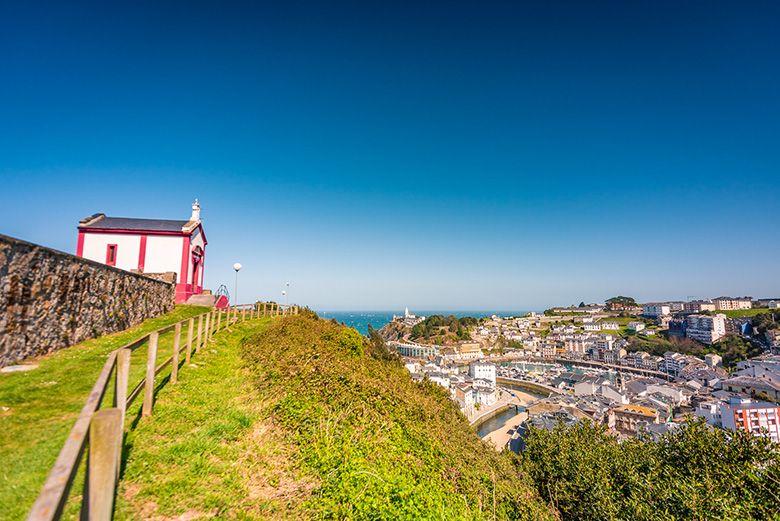
From the El Chano viewpoint, which lies at the foot of the San Roque chapel, your gaze will be ‘captivated’ by such beauty: the beaches of Luarca/Ḷḷuarca, the harbour, the Río Negro with all its bridges cutting through the heart of the town, and opposite, the La Blanca chapel, the cemetery and the lighthouse.
You can also take the opportunity to stroll through the El Chano neighbourhood, with its traditional farmhouses and typical hórreos, and its views of the sea. And you may well come across some pilgrims on their way to Santiago, who, as they pass through Luarca/Ḷḷuarca, bid farewell to the ‘White Town’ as they leave via El Chano, heading towards Navia.
The Fonte Baixa Gardens: Europe’s largest private botanical garden lies on the shores of the Cantabrian Sea
In El Chano, you’ll also discover one of Luarca/Ḷḷuarca’s great hidden treasures: the increasingly popular Fonte Baixa Gardens. The history of the gardens is so intriguing that in a few years’ time it may well become a legend, much like that of the Puente del Beso. For these gardens were born out of a great love story: that of the Marquis of San Nicolás de Noras, José Rivera y Larraya, who one day turned up in Luarca/Ḷḷuarca and fell literally and completely in love with the place where today trees, shrubs and plants from all over the world grow side by side, some of them with incredible stories straight out of a fairy tale.

More than 20 hectares, stretching across a spectacular little valley which, like no other, is buffeted by the winds from the Cantabrian Sea, and from which you’ll have superb views of Luarca/Ḷḷuarca.

Thousands upon thousands of azaleas, rhododendrons, camellias, hydrangeas… adorn what is now Europe’s largest private botanical garden, where species thrive that have never before grown outside their natural habitat.
As if that were not enough, the garden is dotted at every turn with artefacts and antiques of great artistic value, brought from different parts of the world, mainly from Europe and Spain. Roman columns, the table at which Leonardo da Vinci dined, a convent door, a humble bench from rural Asturias, a figurehead, a fountain that once belonged to the House of Alba and many more curiosities, will surprise you on this wonderful stroll through the Fonte Baixa Gardens, where you’ll also have an exceptional guide: José Manuel Alba from Valdes, one of the botanical masterminds behind this miracle of nature.
The best beaches to delight your senses
The municipality of Valdés also stands out for the beauty of its beaches. Vast stretches of sand and secluded coves make up a coastline that always has unexpected surprises in store.
One of Valdés’s most famous beaches is Cueva, just 7 kilometres from Luarca/Ḷḷuarca. It is an idyllic spot, perfect for a hippie-style life in the great outdoors. Imagine a fairytale village, the mouth of a pure, crystal-clear river like the Esva, and a vast beach where you can lose yourself in swimming, walks and gentle sunsets or incredible sunrises.
The River Esva offers wild landscapes and a wealth of natural beauty. So, if, after your stay on the coast, you fancy it, you always have the option of following the Hoces del Esva trail. You’ll see incredible scenery and villages such as San Pedro de Paredes, and, with a bit of luck, one of the many otters that inhabit the River Esva.

Another beach you simply mustn’t miss is Otur, a stunning stretch of sand set against a backdrop of rocky and lush green landscapes, whose waves are a delight for the best surfers and for anyone wishing to take up the sport.
Planet Barayo, the realm of dunes and marshes
Barayo is much more than just a beach. The panoramic view from the green area of the car park doesn’t do it justice. That’s why it’s essential to explore this Nature Reserve from end to end, walking amongst marshes and enormous dunes, to reach the coastline – a vast stretch of sand where the best waves break and strong winds blow.

This protected landscape on the west coast of Asturias forms the natural boundary between the municipalities of Valdés and Navia, and is where the River Barayo flows into the sea. Woodlands, scrubland, cliffs, bridges and abandoned buildings… A unique setting where, if you’re a fan of flora and fauna, you’ll find unique species, and where you’ll feel as though you’re in the midst of a tranquil jungle. What’s more, the sand at Barayo is among the finest in the whole of Asturias, making it a real delight for sunbathing and swimming.
The truth is that this short walk through the nature reserve is the perfect outing to enjoy the extraordinary landscapes offered by the Asturian coast in the municipality of Valdés.
The Park of Life, a venue for science communication
Parque de la Vida is currently closed to the public and no reopening date has been announced. We recommend checking the latest information before planning a visit.
Very close to Luarca/Ḷḷuarca lies the Parque de la Vida, a science centre dedicated to bringing the public closer to life in all its many facets. Its programme combines content relating to astronomy, the oceans, the Earth’s evolution, the origin of life and the conservation of flora and fauna.
Through its various exhibition spaces, the Parque de la Vida takes visitors on a journey through the history of the planet and some of the major themes in science, from the depths of the sea to the heavens. Science communication is further complemented by content highlighting the importance of protecting ecosystems and moving towards more sustainable models.
The centre has also hosted numerous educational activities and workshops, some of which focus on reptiles and other species, reinforcing its educational and outreach role.
Would you like to visit these places?
During this year 2026 you can take advantage of a great discount with the Asturias Rural Tourism Voucher.
You pay 75 € and get 150 €. In addition, each person can buy up to 2 vouchers, so if your partner or companion also buys theirs, you can extend the getaway several nights in a row in the same accommodation.
You can use it from 2 February to 31 December 2026, except:
- 1st May
- Maundy Thursday and Good Friday
- From 1 July to 15 September
Valid in more than 350 rural accommodations throughout Asturias: houses, flats and charming rural hotels ideal for travelling alone, as a couple, with your family or with your group of friends.
Travelling creates memories... and in Asturias, even more 💚
Subscribe to our newsletter and take advantage of offers, discounts, and news
Subscribe


