Camín de la Reina
- Sotu, Cangues d'Onís/Cangas de Onís Eastern Asturias
- Distance: 12.1 kms
- Difficulty: Easy
- Cumulative difference in altitude: +226 m
- Cumulative difference in altitude: -230 m
- Maximum altitude: 141 m
- Minimum altitude: 38 m
- IBP index: 39
- Modality: Families
- Type of route: Linear
- Route type: Mountain
- Return by Train: No
The Camín de la Reina is a hiking route that crosses the heart of eastern Asturias, linking Sotu with Cangues d'Onís/Cangas de Onís along a route steeped in history, landscape and rural tradition. It runs along part of an ancient Roman road built by the VII Legion during the mandate of Emperor Galba in the year 67, whose objective was to connect León with Suances (Cantabria), passing through La Estación/Lugo de Llanera. However, the current name comes from a more recent event: the passage of Isabel II along this same road during her visit to Cuadonga/Covadonga in the summer of 1858, which gave it the popular name of Camín de la Reina (Queen's Way).
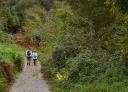
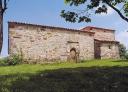
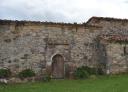
The route begins in Sotu, where a well-defined path leads through meadows, groves and small villages, a reflection of the traditional Asturian landscape. You soon reach Llames, where the church of San Martín de Escoto stands out, of medieval origin and sober structure, next to the Llames fountain, a good place to take a break.
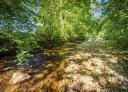
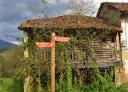
From here, the path continues towards Viabañu, alternating between open areas and shady stretches under indigenous trees, while the road is reminiscent of the route of the old Camino Real. The atmosphere is silent, rural, interrupted only by the singing of birds or the murmur of a fountain.
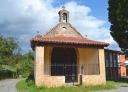
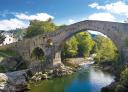
Further on, the route crosses Romiyu, where the simple chapel of San Lorenzo is a reminder of the religious and communal nature of these paths. The next village is Romiyín, which marks the beginning of the last stretch before reaching Cangues d'Onís/Cangas de Onís. The landscape here opens up more, showing the undulating topography of eastern Asturias and preparing the walker for the symbolic end of the route: the arrival at the Roman Bridge of Cangues d'Onís/Cangas de Onís, emblem of the Principality of Asturias, under whose arch hangs the iconic Victoria Cross.
From this point, you can return on foot along the same path or use public transport to return to Sotu, which allows you to adapt the route to the abilities and interests of each person.
The Camín de la Reina is not only a route connecting villages, but also a living historical testimony to the passage of emperors, queens and entire generations of walkers. A journey that invites you to discover the rural soul of Asturias, walking calmly between churches, fountains, meadows and memory, at the leisurely pace of the paths that stand the test of time.
- It runs partially through the Río Sella SAC of the Natura 2000 Network.
- The route partially coincides with the GR-105 and GR-108.
Basic tips before going into the mountains
- If you go with a dog, always keep it on a leash.
- Avoid approaching livestock.
- If you find mastiffs protecting livestock, do not approach them, do not pet them and do not feed them. Do not allow them to follow you or stray from their herd. They are working.
- Don't leave a trail. Collect all your waste, including organic waste. Nature is not a dumping ground.
- Act with prudence. Plan your route well, take everything you need and make sure it is adapted to your physical capacity.
 More recommendations for planning your route