Pico el Arbolín
- Cangues D'Onís/Cangas de Onís, Llueves, Celango, H.elgueres
- Distance: 13 kms
- Difficulty: Moderate
- Cumulative difference in altitude: +585 m
- Maximum altitude: 575 m
- Minimum altitude: 75 m
- IBP index: 50
- Modality: Hikers
- Type of route: Circular
- Route type: Mountain
- Return by Train: No
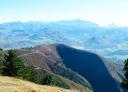
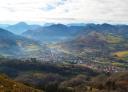
This circular route proposes a journey from Cangues D'Onís/Cangas de Onís along the rivers Güeña and Sella to Picu el Arbolín. Along this route, the path gains height towards the village of Llueves, the landscape is transformed and you can visit historical places such as the rock with the inscription of King Favila or the Buxu Cave. The culmination at Picu el Arbolín gives the walker one of the most spectacular 360º panoramic views of the region, with views of the Picos de Europa and the Cantabrian Sea.
We start the route from the Town Hall square; in less than five minutes, we will be in the middle of nature. We leave the Plaza Camila Beceña behind us, walking along the Avenida Covadonga in the direction of Arriondas/Les Arriondes and, shortly afterwards, take the second street on the right. After 100 metres, cross the bridge over the river Güeña. Immediately after the bridge, we take a cobbled footpath that continues along the right bank of the river. This path quickly takes us out of Cangas de Onís, skirting the back of the Secondary School and the Municipal Sports Centre, always close to the river Sella.
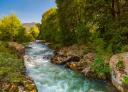
The first point of interest is just after passing the Sports Centre: the "Golondrosu", a narrowing of the river Sella of special beauty. There, there are some stone stairs that go down to the river up to a mobile metal footbridge. The Golondrosu is one of the many fishing preserves frequented by trout, sea bream and salmon anglers, whose season is famous for the public auction of the "Campanu", the name given to the first specimen caught. Afterwards, the cobbled path gives way to a dirt track that runs parallel to the river. It is a flat stretch with plenty of shade due to the abundant riverside vegetation that populates both banks. Continue for approximately one kilometre until a stream crosses the track.
A few metres further on, turn off to the right onto a small track. After 150 metres we reach the entrance to a private estate, where we cross the stream on the right and continue along a narrow cobbled path that crosses a steep slope for 300 metres. A little further on the path changes to a track and the last few metres, until you cross a road, are paved with concrete. We are on the local CO-1 road that links Cangas de Onís with Llueves. We continue the ascent to the village of Llueves, which welcomes us with a small square from which there are three branches; we take the first one to the right. Two hundred metres further and we are at the church of Santo Toribio. Just 50 metres away, facing Cangas and almost hidden, we find a carving on a rock with the inscription: "A bear killed King Favila. Year 739". This is the tribute that the Dukes of Montpensier commissioned in 1857 to commemorate the place where King Favila, son of Don Pelayo, was killed by a bear during a hunt. We go back to the church of Llueves, skirt it and continue walking in a northerly direction towards the slope of Pico del Arbolín.
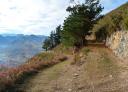
Although there are several crossroads, we must always continue along the asphalted track in an upward direction. We leave the last houses of the village behind us and, after 150m, we take a marked turning to the right signposted GR-109. From here, after 50 metres of asphalt, we return to walking on a stone and dirt track. The ascent is comfortable, as the track, of timber origin, zigzags several times. From this point, there are many places to stop and observe the wide valleys. We can look for a bird's eye view of the silhouette of the Roman bridge in the town centre of Cangas de Onís and discover the peaks of Picos de Europa. Always heading upwards, pay attention to the second turning on the left; while the GR-109 signs continue in an easterly direction, we take this turning which, in just under 1 kilometre, leaves us on a marked hill with a small building and a metal tower with telephone repeaters.
There is just one last effort left to reach the summit of "Picu el Arbolín". To the right of the building, to the east, there is a small path that ascends almost straight up the ridge to the summit. It is easy to see, as the hillside is deforested and we will only find scrubland, some hawthorns or small patches of pine forest. The summit, marked by a pile of stones or "jitos", offers a 360º view: to the northwest the Sueve mountain range and the coast of Ribadesella; to the east the Escapa and Cuera mountain ranges; and to the south the Picos de Europa massifs, the Sella Gorge and peaks such as Pierzu, Tiatordos and Mota Cetín.
This mountainous formation serves as a natural barrier to the cloud fronts from the Cantabrian Sea. It is common to see the clouds retained on its summit, a phenomenon known as the Foehn effect, which has given rise to the famous phrase: "When the fog comes out of the Picu'l Arbolín there is no water missing from the mill". We start the descent following the ridge in an easterly direction along an entertaining up and down path. At the end of the ridge we reach a track that continues the descent in a southerly direction. We walk for a little over a kilometre, losing height until we cross another track that crosses the mountain from east to west; the junction is at a small pass where we turn right towards the village of Celango.
From Celango to the village of Jelgueres we descend one kilometre along a tarmac road. The first building in Jelgueres is an industrial building located on a sharp bend; about 50 metres before, on the left, a concrete track descends that takes us into the village until we reach the church dedicated to San Ramón. Skirting the church we continue to the left towards the west and quickly leave the village. The asphalt becomes a path that, between the walls of old farms, crosses a forest of autochthonous species (oak and hazelnut trees). The track comes out onto an asphalted country road next to a livestock building; turn right and in 1 kilometre we reach the Guardia Civil barracks in Cangas de Onís. A little further on we find the Güeña river promenade, which we walk along its right bank until a wide pedestrian bridge allows us to change banks and, in just 500 metres, return to the Town Hall square.
If we wish to shorten the route, there is the option of starting the itinerary in the village of Llueves, where it is easy to find a car park. For the return, the descent can be made along the same path as the ascent, which takes about an hour and a half; or you can walk along the entire ridge and, once you have started the descent along the dirt track, take the second branch to the right. This second diversion, signposted with the GR-109 signs, connects after one kilometre with the original ascent path, a few metres below the repeater hut, completing a variant that takes about two hours. On the other hand, to extend the route, when you reach the village of Celango - where the track comes out onto the road - you can take a flat path to the left, heading west, which leaves the village in a few metres. This path crosses some meadows and begins a steep descent to the village of Cardes, where you will find the signs to the Cueva del Buxu, a prehistoric cave with engravings and cave paintings whose visit should be arranged in advance at the Cangas de Onís Tourist Office. Finally, from Cardes we continue the descent along the CO-3 road to the bridge over the river Sella, where just before crossing it, the asphalted local road begins on the right, leading to Cangas de Onís on a comfortable flat stretch, which takes about three quarters of an hour to complete.
Basic tips before going into the mountains
- If you go with a dog, always keep it on a leash.
- Avoid approaching livestock.
- If you find mastiffs protecting livestock, do not approach them, do not pet them and do not feed them. Do not allow them to follow you or stray from their herd. They are working.
- Don't leave a trail. Collect all your waste, including organic waste. Nature is not a dumping ground.
- Act with prudence. Plan your route well, take everything you need and make sure it is adapted to your physical capacity.
 More recommendations for planning your route