Villabona Route
- Villabona Central Asturias
- Distance: 9.4 kms
- Difficulty: Easy
- Cumulative difference in altitude: +265 m
- Cumulative difference in altitude: --265 m
- Maximum altitude: 272 m
- Minimum altitude: 92 m
- IBP index: 39
- Modality: Families
- Type of route: Circular
- Route type: Mountain
- Return by Train: Yes
- RENFE
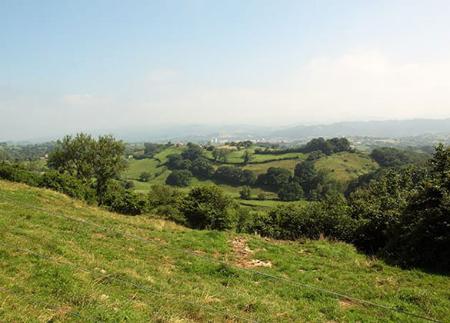
From ancient paths you can sense forgotten stories and enjoy wide views towards the centre of Asturias. Nature, memory and landscape are intertwined in this easy route, close and full of authenticity.
Just twenty minutes from Oviedo, Gijón or Avilés, the Villabona Route reveals a surprising corner of the council of Llanera, where ancient history and rural landscape come together in a simple and accessible route. The starting point is the Villabona train station, a construction inspired by that of Liverpool, the first railway station in the world, which already anticipates the heritage value of the surroundings.
The path takes us first to the Barandiallu area, which at first glance may seem like an ordinary meadow, but which hides exceptional archaeological remains beneath its surface. Excavations carried out in the 1980s revealed traces of human occupation between 50,000 and 100,000 years ago, possibly by Neanderthals, which makes this enclave one of the oldest in the Principality of Asturias.
The route runs through an eminently rural landscape, dotted with traditional quintanas - with their houses, stables and hórreo - scattered among meadows, cornfields and eucalyptus groves. The peaceful atmosphere is ideal for watching birds of prey, the song of a woodpecker and even the occasional sighting of roe deer.
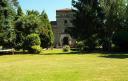
Among the heritage elements along the route, the church of Villardeveyo, of pre-Romanesque origin, stands out, and on the other side of the valley, the Palace of Villabona, a magnificent example of Baroque architecture from the 17th century. Declared an Asset of Cultural Interest, it was built between 1661 and 1669 by the Alonso de Villabona family on top of an earlier building. Its tower, which houses a chapel dedicated to the Three Wise Men designed by Juan de Naveda, preserves a Romanesque doorway from the monastery of Santa Clara in Oviedo. The palace complex, also known as the Palace of the Count of San Antolín, has noble coats of arms, a courtyard with Tuscan columns and a carved wooden corridor that reflect the stately splendour of the period.
The itinerary, which is a circular route of low difficulty, starts at the station and follows the main street to a roundabout, from where it takes the right-hand branch along the AS-325 road. At kilometre 1.5, leave the asphalt and continue along a path that leads to the archaeological excavations and, further on, to the hamlet of La Vega, with its granaries and traditional well.
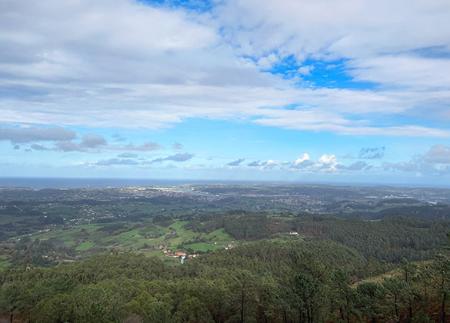
After crossing the railway tracks through a tunnel, the path ascends between houses and a wooded stretch. Outside the forest, at kilometre 4, the path forks; take the right-hand branch and continue straight on. From here you can see Gijón and the Asturias prison. Near the Cogersa installations, we turn left to continue between chamomile and dandelion meadows.
The final section, along the LL-9 road, passes by the church of Villabona and its centenary yew tree before crossing the train over a bridge and returning to the starting point.
This route is ideal for those looking for an easy walk with archaeological, scenic and cultural content, very close to large urban centres. A complete experience that combines remote history, noble heritage and Asturian rural life in just a few hours.
Basic tips before going into the mountains
- If you go with a dog, always keep it on a leash.
- Avoid approaching livestock.
- If you find mastiffs protecting livestock, do not approach them, do not pet them and do not feed them. Do not allow them to follow you or stray from their herd. They are working.
- Don't leave a trail. Collect all your waste, including organic waste. Nature is not a dumping ground.
- Act with prudence. Plan your route well, take everything you need and make sure it is adapted to your physical capacity.
 More recommendations for planning your route