San Andrés de Bedriñana
- Villaviciosa Eastern Asturias
- Address: 33315 - Bedriñana
- Phone: 689 712 803
- Schedules and prices: View
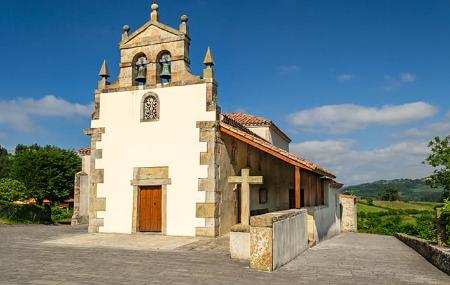
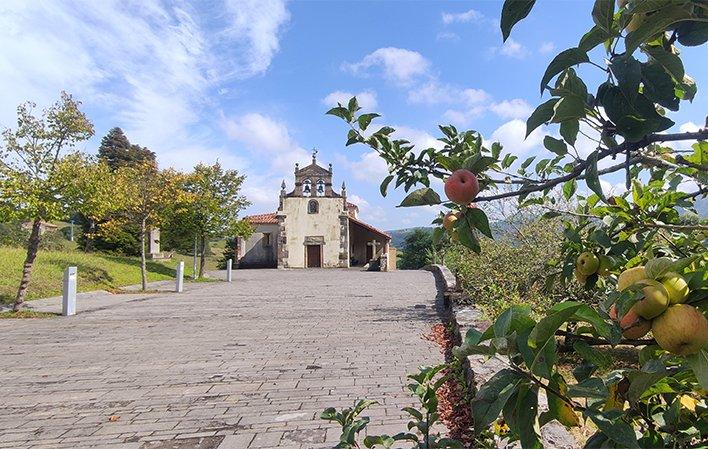
In the parish of Bedriñana, in the council of Villaviciosa, there is an emblematic church that embodies the evolution of religious architecture in Asturias. It is a key piece in understanding the transition from Asturian Pre-Romanesque to rural Romanesque. Despite the alterations it underwent throughout the Late Middle Ages and the Modern Age, it still retains its early medieval essence. It was declared a National Monument in 1931.
History of San Andrés de Bedriñana
Asturias was a key enclave in the resistance to Muslim advances, and the architecture of the period reflected this situation through temples with a fortified appearance and small dimensions. This is the case with the original appearance of San Andrés de Bedriñana. Its hard pre-Romanesque core has remained largely intact, allowing historians to reconstruct its history and evolution.
Origin and historical context
Although there is no conclusive material evidence, the place name Bedriñana suggests a continuity of settlement since Roman times. The church that bears this name extends its roots to its foundation, probably at the end of the 9th century. Its construction, promoted by the nobility settled in this enclave (originally "Villa Vidriniana"), imitated the style of the nearby church of San Salvador de Valdediós.
The first documented reference to San Andrés de Bedriñana dates from 1023, when it is mentioned in the consecration of another church in Villaviciosa: San Salvador de Fuentes. An inscription recorded the donation of the town of Bedriñana and its assets by Diego Pepici and his wife Mansuara; a clear example of how the local elites ensured their influence through ecclesiastical patronage. In the 12th century, the church was placed under the tutelage of San Salvador de Priesca, as recorded in the "Liber Testamentorum", a medieval codex preserved in Oviedo Cathedral.
Restoration and conservation
The restorations carried out on the church of San Andrés de Bedriñana have played a fundamental role in preserving its structure and its oldest architectural elements. Over the centuries it underwent multiple transformations which, while adding historical and artistic value, also modified its original configuration. A rigorous process of archaeological analysis was necessary to understand its evolution and to establish the most appropriate conservation criteria.
Between 2002 and 2004, excavations were carried out that accurately identified the genuine remains of the building, bringing to light traces that had remained hidden or altered by later interventions. The 2005 restorations succeeded in restoring the temple to an appearance more faithful to its medieval design, confirming its relevance within the Asturian Pre-Romanesque Art as a whole.
Architectural features
Its design combines original elements with later alterations that reflect Romanesque and Baroque influences. These transformations are evidence of the church's adaptation to the liturgical and aesthetic needs of each period, enriching its physiognomy on the basis of its original construction.
Original pre-Romanesque elements
The walls of San Andrés de Bedriñana still exude pre-Romanesque art. Its single nave, with a rectangular floor plan and straight headwall, shares style and proportions with the central nave of the church of Priesca - built in the same period -. The original roof, probably made of wood, rested on corbels, some of which are still preserved.
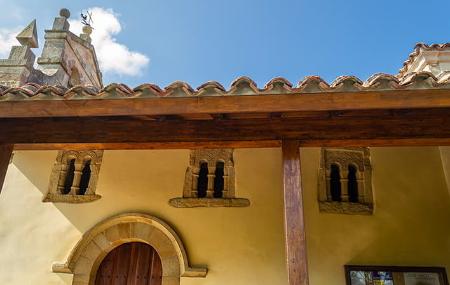
On the western façade, a masterfully carved latticework dominates the whole. It unfolds with flowing, harmonious branches in the Andalusian style. Its design is even more refined than that of the southern latticework of San Salvador de Valdediós, which seems to have inspired it. The windows on the north and south walls also follow a characteristic design; small horseshoe arches framed by a decorative moulding. The façade of the church maintains another original element of its early medieval construction: the western doorway, formed by an undecorated monolithic lintel and jambs, following the typical model of the period.
Archaeological excavations revealed the existence of burials inside the temple, indicating a funerary use since its foundation. Among the findings were two child burials in the apse. Radiocarbon dating places its age between the 7th and 9th centuries, which reinforces the early medieval chronology of this construction.
Integration of subsequent styles
Time has not passed in vain in this church, which has been almost completely remodelled throughout its history. In the medieval period of the 12th and 13th centuries, a Romanesque doorway and a triumphal arch were added; later, in the Baroque period, its original chancel was sacrificed to build the chapel of the Valdés Sorribas family. Some of its original corbels were reused in the main chapel, and new structures enveloped the original church - chapels, a sacristy and a chapterhouse.
The belfry of San Andrés de Bedriñana is a structure added in the 19th century. Baroque in style, it has two openings for bells and a triangular top with a pediment. Its construction required the gable wall to be raised, and during this intervention the pre-Romanesque latticework, which was originally located above the doorway, was moved to a higher position.
Recommendations for visitors
This cultural visit is an excellent opportunity to visit other historical monuments in the area, such as San Salvador de Valdediós.
Schedules and prices
- July and August
Tuesdays and Fridays: 17:00 to 19:00 - Rest of the year: ask for availability by phone.
- Free