Santianes de Pravia
- Pravia Asturias Centre
- Address: El Palacio 33129 - Santianes
- Phone: 985 821 204 684 643 740 | (imprescindible reserva previa)
- Email: oficinaturismo@pravia.es
- Site: Visit
- Schedules and prices: View
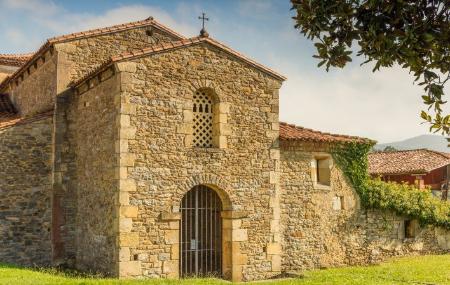
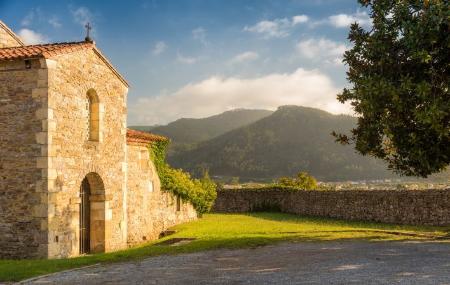
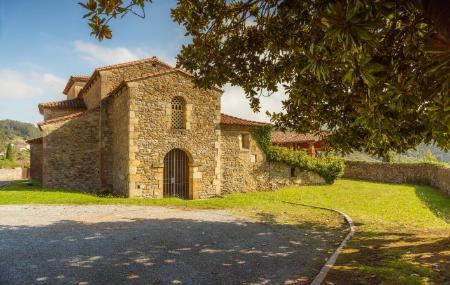
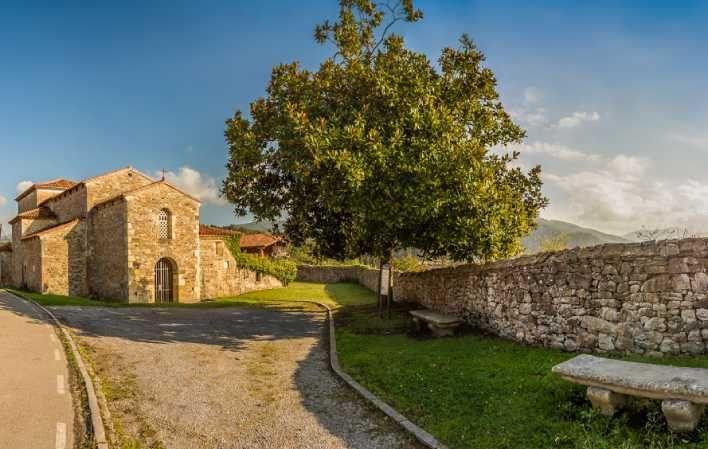
The church of Santianes de Pravia is a key testimony to the beginnings of medieval architecture in Spain. A missing link between two worlds: Visigothic art and the birth of the Asturian Pre-Romanesque. Archaeological remains also suggest that the church may have been built on top of a late Roman building.
History of Santianes de Pravia
The church of Santianes de Pravia is a reflection of the Kingdom of Asturias in its first decades; a kingdom still under construction that sought to consolidate its identity and dominion.
Origin and historical context
When King Silo moved the Asturian court to Pravia between 774 and 783, he not only changed the geography of power, but also laid the foundations for a new artistic and political cycle. Pravia, heir to the Roman Flavium Avia, offered a strategic position far from the mountainous isolation of Cangas de Onís. It was in this context that Santianes de Pravia, the oldest church in the Asturian Pre-Romanesque period, was born.
Conceived as a palatial oratory and royal pantheon, the church of Santianes was founded under the dedication of San Juan Evangelista (hence "Sancti Joannis / Santianes"). It was integrated into a palace complex of uncertain location that briefly housed the Pravian court before its definitive transfer to Oviedo. According to chronicles from the time of Alfonso III, King Silo was buried in the portico of the temple, while his wife, Adosinda, granddaughter of Don Pelayo, was forced to retire to the monastic life, respecting the traditions of her lineage.
Reforms and restorations
Santianes de Pravia has undergone so many alterations that reconstructing its original appearance has required meticulous archaeological work. Although it remained unaltered until the beginning of the 17th century, Don Fernando de Salas, after obtaining the privilege of being buried inside it, undertook a thorough reconstruction of the chancel at this time. In the 19th century, new interventions significantly altered the church. The original portico with the royal burial area on the west façade was removed and a belfry was erected. The physiognomy of the church became increasingly distant from its original appearance.
Key figures in 16th and 17th century historiography had documented the state of the church before these substantial changes. Thanks to them, the plan, distribution and pre-Romanesque elements of the church were known, valuable information that was used in the contemporary restorations. In 1975 and 1980, archaeological studies confirmed the existence of a semicircular, perpendicular chevet, typical of Paleochristian and Visigothic models. These studies, under the direction of José Menéndez Pidal, were extended to restoration work (in some respects somewhat pretentious) to eliminate late additions and recover the early medieval appearance. The 19th-century façade was relocated and a royal tribune was designed which, according to current experts, was inspired by temples somewhat later than those of the Pravian court.
Architectural features
Santianes de Pravia was declared a Historic-Artistic Monument in 1931. It is currently in a good state of conservation and its most important architectural elements can be seen both in situ, in the church itself, and in the Santianes Pre-Romanesque Museum (annexed to the church), where archaeological remains recovered from excavations are on display.
Original pre-Romanesque elements
The interior still conserves semicircular arches on square pillars, inherited from Visigothic architecture, which later became a characteristic feature of Asturian art until the arrival of the Ramirense period.
Another of its most singular elements is the immersion baptismal font, excavated in the floor of the right nave. Its presence is somewhat exceptional in the Asturian context of the 8th century, which has led to the hypothesis that the church of Santianes was not a completely new construction, but a reconstruction of a pre-existing early Christian basilica.
Decoration and symbolism
The church of Santianes de Pravia preserves fragments of Silo's acrostic, an inscription confirming the royal patronage of the temple. The phrase"SILO PRINCEPS FECIT" (PRINCE SILO DID IT) was engraved on a labyrinthine stone and could be read in multiple directions from a central "S"; it was repeated more than 45,000 times. Although the original tombstone was lost, some fragments can still be seen in the church and in the Pre-Romanesque Museum, where there is also a replica that shows what it looked like in its entirety. The museum houses other pieces of great archaeological value, such as decorated gates, epigraphic inscriptions and a relief engraved in great detail on a slab that could represent the palace of Silo and Adosinda.
Inside the church there is an extraordinary Romanesque Calvary from the late 12th or early 13th century, consisting of a crucified Christ and two figures mourning his death. The Christ has a mutilated left arm and remains of burns after being thrown into the fire during the Civil War.
Opening times and recommendations for visitors
The church of Santianes de Pravia is not always open to the public, so it is essential to make an appointment by telephone on 985 821 204 or by email: oficinaturismo@pravia.es.
When visiting the church we can take the opportunity to visit the Pre-Romanesque Museum of Santianes, an installation where not only archaeological pieces are exhibited, but also models, information panels and a complete audiovisual presentation on the court of King Silo.
To complete a fantastic cultural day like this, we can visit Somáu, a beautiful location just 8 kilometres away, which was an Exemplary Town of Asturias 2020, and which will surprise us with another marvellous architecture: the architecture of the Indianos.
Info
The church of San Juan Apostol y Evangelista is the oldest of the pre-Romanesque churches in Asturias and was ordered to be built by the kings Silo and Adosinda, who moved the capital of the Asturian Kingdom to Pravia (774-783).
Located in the municipality of Pravia, of the original basilica built in 780, only a few remains remain in the central nave and the side walls. It consisted of three naves with a transept and three rectangular chapels. Over the entrance arch to the transept there was a labyrinthine inscription formed by the words Silo Princeps Fecit, and a vestibule served as the Royal Pantheon. The arches were semicircular on square pilasters and the roof was made of wood.
The main altar is a replica of the original, which has been in the crypt of the church of Jesús Nazareno in El Pito (Cudillero) since 1984. The belfry, built in 1868, which stood at the foot and did not correspond to the original construction, was attached to the south sacristy in the last restoration carried out by D. Luis Menéndez-Pidal y Álvarez between 1979 and 1980.
As pre-Romanesque remains, it conserves parts of the columns of the triumphal arch, two small windows with horseshoe arches, a twinned one, and several catalogued remains found in the sacristy. It has an interesting Romanesque calvary in the south arm of the transept.
Built in: 780Schedules and prices
- Sunday: 11:00
- Free