
Castro de Mohías
- Coaña Western Asturias
- Address: 33719 - Mouguías/Mohías
- Schedules and prices: View
- Free admission
Images
Info
The hill fort was first described in 1940 by Antonio García y Bellido and Juan Uría; however, excavation work did not begin until 1968, when Jesús Martínez Fernández, initially in collaboration with Juan Manuel Junceda Avello, and subsequently on his own, carried out several archaeological campaigns which yielded, amongst other findings, the first carbon-14 dating of an Asturian hill fort; his results were published in a series of articles and books.
From 1971 onwards, the researchers Emilio Olávarri, Francisco Jordá (with Javier González-Tablas) and Elías Carrocera took over, carrying out occasional work without any continuity. No excavation work has been carried out since 1989.
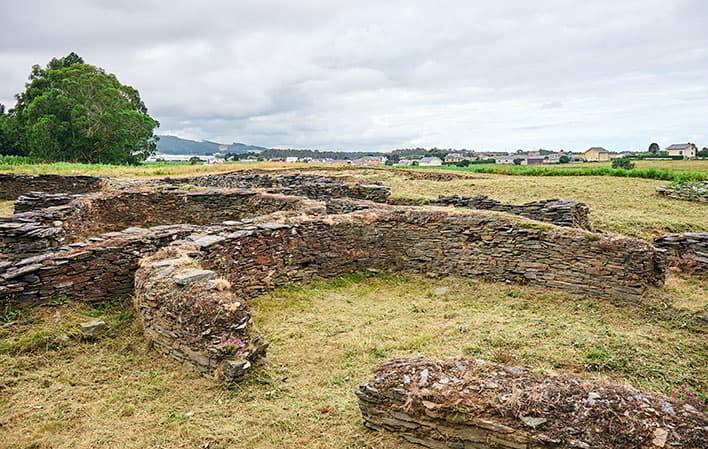
The settlement extends across a broad plateau, bounded to the north and west by the Jarrio stream. To the south, its most vulnerable flank, the settlement was protected by several lines of ditches – deep trenches carved into the rock, the original dimensions of which are revealed by the test pit dug in one of them – and these are easily distinguishable by visitors along the path leading to the inner enclosure. A perimeter wall completed the fortification of the castro.
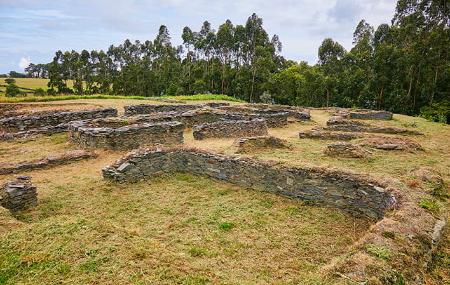
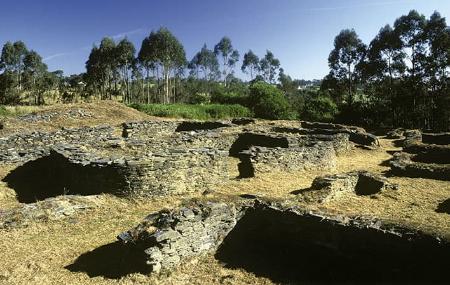
Excavations have uncovered some 20 structures within the fortified enclosure, amongst which one can distinguish buildings of local tradition, characteristic of the Iron Age (with curvilinear floor plans), alongside others adapted to construction patterns typical of the Roman period (huts with a layout featuring straight walls and several rooms separated by internal partitions). Taken as a whole, the buildings are arranged in a layout adapted to the defensive perimeter.
Inside, hearths were discovered, along with mortars fashioned from granite blocks similar to those found at Coaña, and an abundance of pottery, which provides evidence of the settlement’s occupation during the centuries immediately before and after the turn of the era. The indigenous pottery from Jesús Martínez’s excavations appears to confirm this. It was occupied throughout the 1st and 2nd centuries AD, though there is no conclusive evidence of its occupation in the early medieval period.
How to get there: Jarrio-Ortiguera local road (600 m from the hospital). Turn off onto the track leading to the local football pitch (400 m).
Built in:1st and 2nd centuries
Schedules and prices
- Self-guided tour
- Free