
A guide to enjoying the eclipse in Asturias: tips and timings
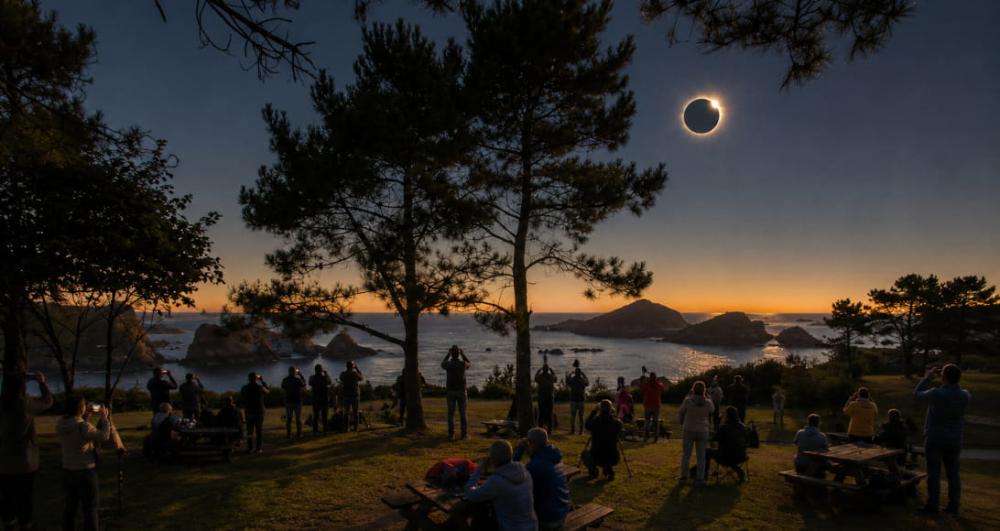
On 12 August 2026, Asturias will be one of the best places in the world – weather permitting – to witness an exceptional astronomical phenomenon: a total solar eclipse. A large number of visitors are expected, so it is advisable to plan your day in advance and follow some simple guidelines to ensure you can enjoy the spectacle in complete safety.
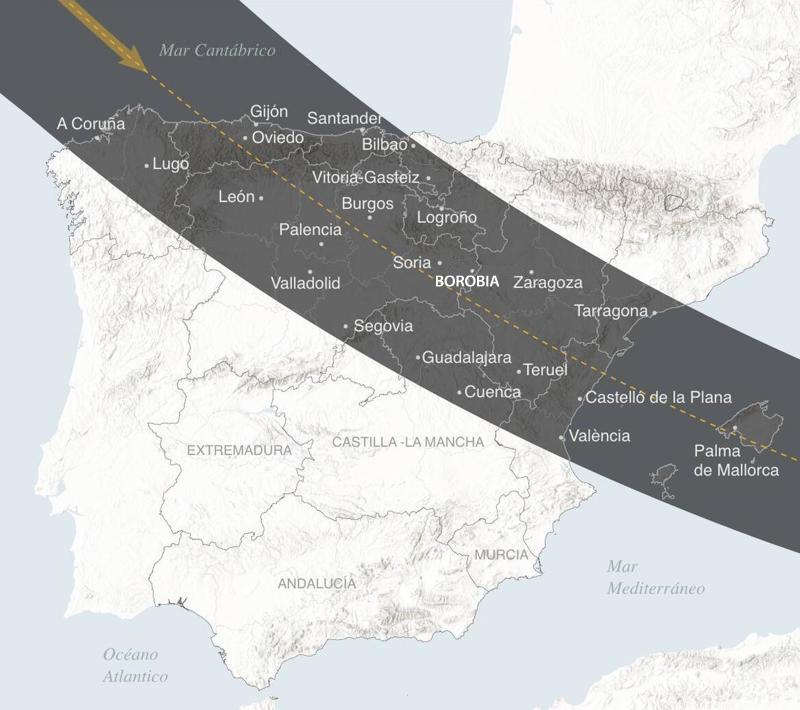
Geographical path of the 2026 total solar eclipse
Plan your day
The eclipse will attract thousands of people to various locations across Asturias. To enjoy the experience safely, please read the safety recommendations for viewing the eclipse and bear in mind the following advice:
• Check the weather forecast before you set off.
• Take water, sun cream, a hat and something warm to wear for the end of the day.
• Follow the instructions of the security services at all times and avoid parking in unauthorised areas.
• If you’re bringing children, make sure they use approved eclipse glasses correctly.
• Avoid walking or driving whilst watching the eclipse.
When will the eclipse take place?
As a guide – and given that times may vary slightly depending on the municipality from which the eclipse is observed – in Asturias it will take place according to the following schedule:
• Start of the partial eclipse: around 7.30 pm.
• Start of totality: between 8.26 pm and 8.29 pm.
• End of the eclipse: around 9.20 pm.
The totality phase – the moment when the moon completely covers the sun – will last approximately between 1 minute and 40 seconds and 1 minute and 50 seconds, depending on the viewing location.
Important: The times given are approximate and may vary slightly depending on the town or town from which the eclipse is viewed. Check the exact time for your location and all the practical information here.
What will you be able to see during the totality?
Totality is the most eagerly awaited moment of the eclipse and will last just a few minutes. During that brief interval, you’ll be able to witness some of nature’s most spectacular phenomena:
• The solar corona, the Sun’s outermost atmosphere, normally hidden by the intense brightness of the solar disc.
• The diamond ring, a brilliant flash that marks the start and end of totality.
• Baily’s beads, tiny points of light that appear when the last rays of sunlight pass through the valleys and mountains of the lunar surface.
• A sudden darkening of the sky, similar to twilight, accompanied by a change in the brightness of the landscape and, occasionally, a slight drop in temperature.
Always protect your eyesight
Never look directly at the Sun without proper protection. During the partial phases of the eclipse, you must only usecertified solar viewing glasses that comply with the ISO 12312-2 standard.
Before using them, check that they are not scratched, punctured or damaged, and always purchase them from reputable retailers. Ordinary sunglasses are not suitable for viewing an eclipse.
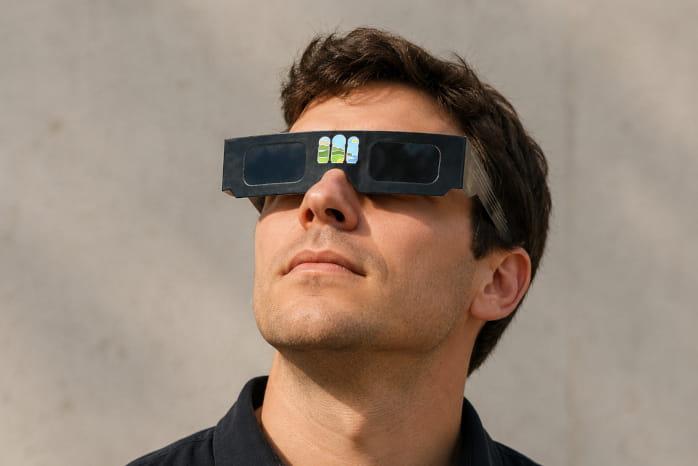
Boy wearing glasses approved for viewing the solar eclipse
When should I wear my glasses?
One of the most common questions is when eclipse glasses should be worn.
During all partial phases, whenever you look directly at the Sun, you must wear approved eclipse glasses.
If you wear prescription glasses, there is no need to take them off. Keep your usual glasses on to see the eclipse clearly and place the approved eclipse glasses over them.
You may only remove them once the last bright spot of the Sun has completely disappeared and totality begins – that is, when the Moon has completely covered the Sun’s disc.
As soon as the first glimmer of sunlight reappears – known as the ‘diamond ring’ – you must put your eclipse glasses back on immediately to continue observing the eclipse safely.
Remember: You do not need to wear the glasses continuously throughout the entire eclipse, but you must wear them whenever you look directly at the Sun, except during the brief period of totality.
Do not use home remedies
X-rays, tinted glass, CDs, photographic negatives, sunglasses or any other improvised materials do not protect your eyes and can cause permanent eye damage.
If you are going to use binoculars, telescopes or cameras, remember that they must be fitted with specific solar filters placed in front of the lens. Never look at the Sun through these devices without proper protection.
Find out more on the official website
To plan your experience in full detail, visit the official Eclipse Asturias 2026 website, where you’ll find:
• The exact timetables for each municipality.
• The 78 recommended viewing spots in Asturias.
• Tips for safe viewing.
• Information on transport, scheduled activities and frequently asked questions.
With good planning and by following the recommendations, all that remains is to look up – always with the appropriate protection – and enjoy one of the most spectacular astronomical phenomena that will be visible from Asturias in the coming decades.