
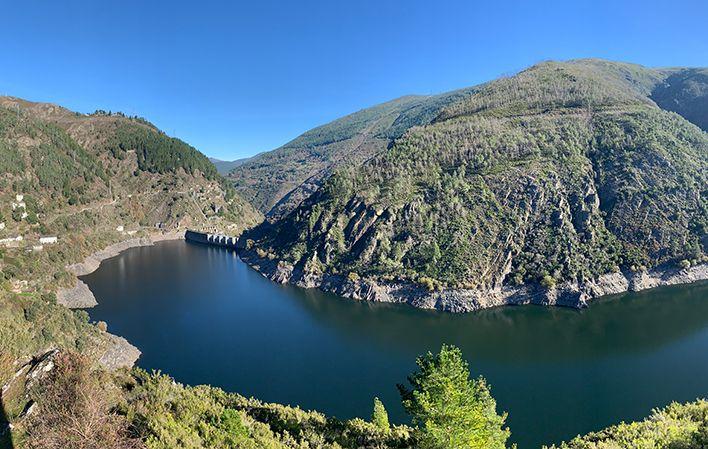
Salime Reservoir
- Grandas de Salime, Ibias, Pesoz y Allande Western Asturias
Info
The Salime Reservoir is one of the most distinctive landscapes in western Asturias and one of the major hydroelectric projects on the River Navia. Its navigable stretch, some 30 kilometres long, offers the chance to enjoy water sports and discover, from the water, a landscape characterised by steep slopes, forests and vast expanses of water.
Beneath its waters lies the ancient village of Salime, which once served as the capital of the municipality. When the water level in the reservoir drops, some remains of its buildings are once again laid bare, serving as a reminder of the profound transformation that the creation of the reservoir brought to this area.
Construction of the dam began in 1946 and was completed in the mid-1950s. The scale of the works required the mobilisation of more than 3,000 workers and the setting up of camps to house them and their families. Among the solutions employed was a spectacular cableway stretching some 37 kilometres, used to transport materials to the construction site.
The complex comprising the dam and the power station also stands as one of the finest examples of Asturias’ industrial hydraulic heritage. A particular highlight of the power station is the artistic contribution of Joaquín Vaquero Palacios and Joaquín Vaquero Turcios, who integrated architecture and art into the infrastructure. Among its best-known features is the large mural in the turbine hall, which depicts the construction of the dam.
On the nearby hillsides, the statue of the Virgen de la Luz is also preserved; it is linked to the memory of the workers who took part in the construction and has become one of the symbols associated with the dam’s history.
The reservoir covers land in Grandas de Salime, Ibias and, to a lesser extent, Pesoz and Allande, as well as extending into the Lugo municipalities of Negueira de Muñiz and A Fonsagrada. The dam and power station are situated between Pesoz and Allande, whilst much of the reservoir covers Grandas de Salime and Ibias.
In addition to its historical and scenic value, Salime continues to serve its purpose of hydroelectric power generation and regulating the River Navia. The Cantabrian River Basin Authority covers a catchment area of 1,806 km² and a volume of approximately 266.3 hm³.
The main access is from Grandas de Salime via the AS-14 road, a route which also offers some of the most characteristic views of the area.