


The Central Mountains have been, since ancient times, the gateway to Asturias from the plateau. This is where the Roman legions entered and this is where a large part of national tourism enters today. The region welcomes the traveller with villages suspended on the slopes, and with the high hills and limestone massifs of the Las Ubiñas-La Mesa Natural Park. Mythical cycling routes wind through mountain passes, forests and river meadows, while in the valleys the mining identity and a rich industrial heritage persist. When the snow covers everything, the ski resorts invite us to conquer the landscape in a more playful way.
History and heritage of the Central Mountains
Like its orography, the heritage of the Asturian Central Mountains is dense and revealing. On the heights of La Cobertoria, Pajares or Piedrafita, Neolithic burial mounds remind us that these mountain passes were crossed thousands of years ago. Later, the Roman legions opened the Vía Carisa, a military road that connected the plateau with the Cantabrian Sea. And in the High Middle Ages Santa Cristina de Lena was built, a small church that embodies the discreet perfection of Asturian Pre-Romanesque architecture - declared a World Heritage Site in 1985. On the Monsacro, the sacred mountain of Morcín, two medieval chapels keep the legend of the Holy Ark, hidden there after the fall of Toledo and later transferred by Alfonso II to the Holy Chamber of Oviedo/Uviéu. That fervour gave rise to the Camino de El Salvador, which starts in León, crosses the Pajares pass and passes through Campomanes and Mieres del Camín - whose name still reflects its Jacobean past. Many pilgrims took this detour, from the French Way, to see first-hand the largest number of relics in Europe.
More earthly, but no less valuable, is the ethnographic collection of granaries and granaries of Bueño, in the council of Ribera de Arriba. Around 50 of these traditional granaries form a veritable open-air museum. An interpretative route runs through the village explaining their history and function, while the Hórreo Interpretation Centre, also in Bueño, offers us more clues to understand this symbol of Asturian rural culture.
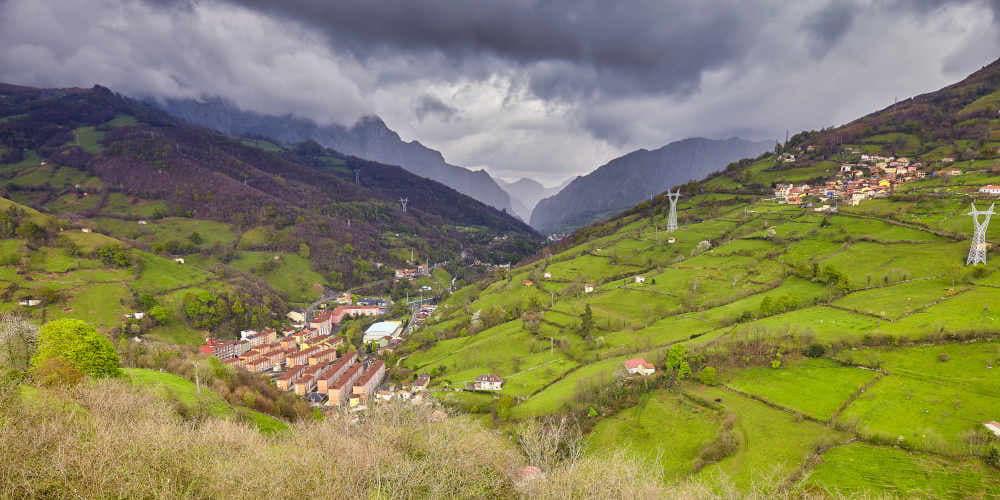
Industrialisation transformed this area into one of the driving forces of the country and left a deeper mark on its valleys than any gallery. In the Turón Valley, the epicentre of Asturian mining, there are still some castles, shafts and a landscape shaped by decades of extraction. The workers' village of Bustiello, an Asset of Cultural Interest, embodies like no other the paternalistic utopia of this era, when the mining companies built churches, schools and casinos at the very foot of the mines. Today, this legacy can be visited on guided tours that also take us to historic shafts such as Santa Bárbara, Espinos or Fortuna.
Landscapes and nature of the Central Mountains
For decades, the Pajares pass solved the secular isolation of Asturias, although today the Huerna motorway, which is faster and just as epic, is the most popular. It runs through one of the most beautiful natural corridors of the Cantabrian Sea: the Huerna Valley, in the council of Lena - a historic pass for muleteers, transhumants and travellers who crossed the Cantabrian Mountains. The four-kilometre-long El Negrón tunnel is more than a work of engineering, it is a sensory frontier, because when you cross it, the plateau fades away, the climate becomes humid and the landscape becomes greener, more rugged, more Asturian.
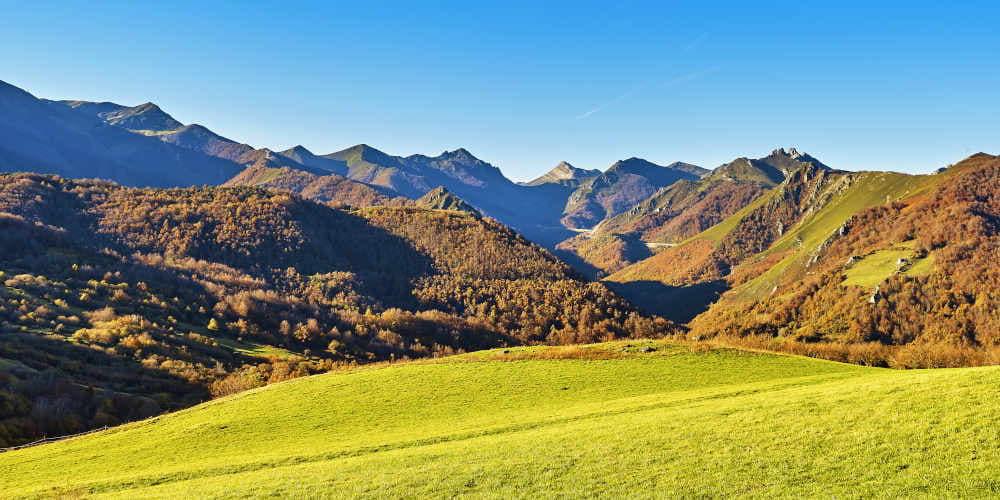
The region is home to a series of areas of the highest ecological value, with the mountains unfolding generously. Natural spaces that the Principality's Administration has taken care to regulate in order to prevent their environmental degradation. In the case of the Sierra del Aramo Protected Landscape, we are talking about a limestone bastion more than 15 kilometres long. On its eastern slope, the Cuesta de Riosa rises with imposing severity, overcoming more than 1,300 metres of unevenness to crown the Gamoniteiru ( 1,791 metres), a mythical peak of national cycling. The walker will find here a geography full of meaning: each valley and fold, each hill, each lagoon has been shaped by centuries of slow walking.
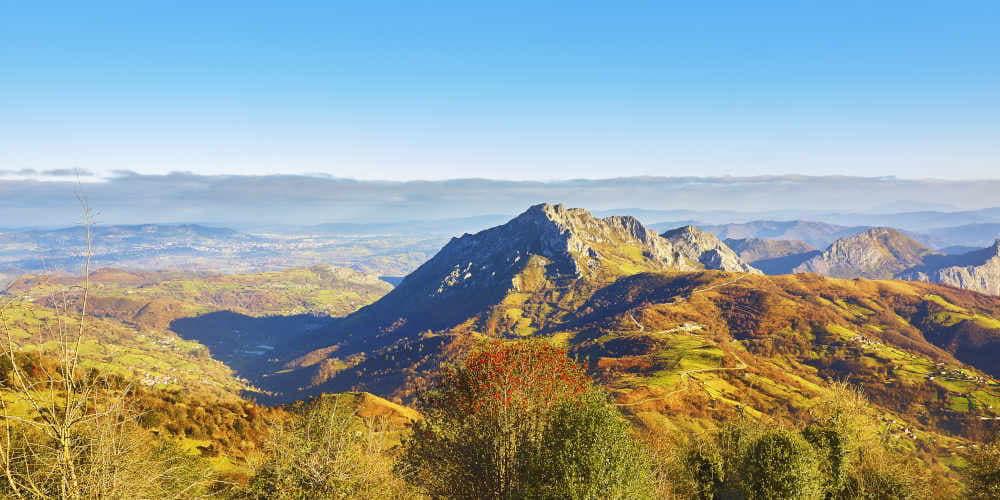
The Las Ubiñas-La Mesa Nature Reserve, a Biosphere Reserve, is one of the best kept secrets of the Cantabrian Mountains. It covers an area of approximately 450 square kilometres, making it one of the largest and best preserved protected areas in the Principality. Native forests and rugged peaks make up a landscape of unspoilt beauty and primitive air, crowned by the imposing silhouette of Peña Ubiña. At 2,417 metres, this peak - the second highest in the Principality - stands like a limestone colossus that attracts mountaineers from all walks of life. Its ascent is a revealing experience: as you gain altitude, the rest of the landscape shrinks to the extreme, as if surrendering to the great mountain. Around it, the glacier sculpted a huge area of rough, harsh, unadorned landscape.
Routes and outdoor activities
The Central Mountains are a paradise for professional cyclists and for all the legions of amateurs and cycle tourists who try to imitate their exploits. In the Aramo mountain range, for example, there is a succession of relentless climbs, the protagonists of several editions of the Vuelta a España. The most emblematic climb is undoubtedly El Angliru, in the municipality of Riosa. A "brutal" pass, with a length of 12.6 kilometres and gradients of more than 20%, it has been a stage finish on several occasions. In the Aramo there is also another epic stage finish: the Gamoniteiru pass, 20.2 kilometres at 7.2%.
The whole region is criss-crossed by top-level cycle touring routes that combine extreme difficulty and scenic beauty. The council of Lena is particularly well endowed. There is the Cuitu Negru with its 23.5 kilometres at 6.1% and ramps at 25%. La Cobertoria: 10 kilometres at 8.5%. El Cordal: 5.6 kilometres at 9%. El Cuchu Puercu (along the Cordal): 11 kilometres at 6.9%, or La Cubilla: 28 kilometres at 4.7%. The "La Cubilla" (opens in a new tab) is one of the most popular in the Asturian calendar. It is held every year in May and is attended by enthusiasts from all over Europe.
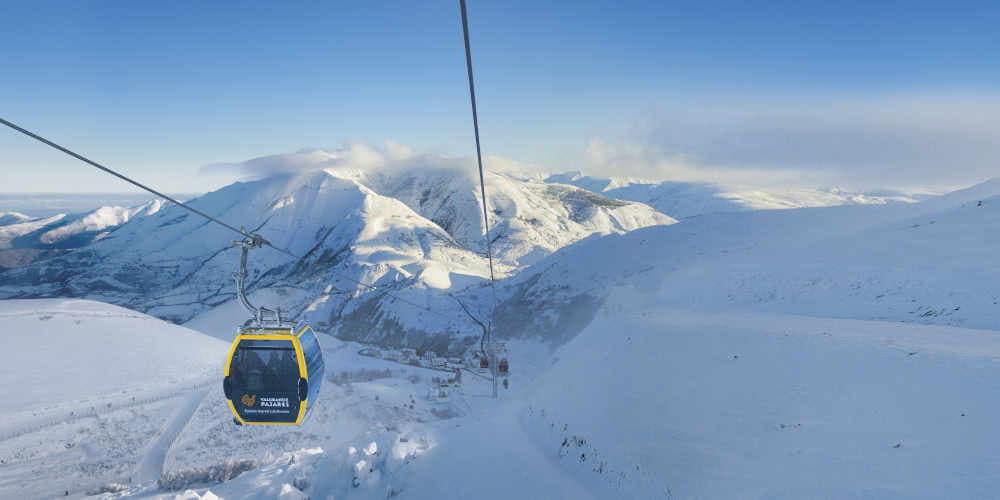
In the Central Mountains, cycling is a major economic driving force. In some councils the income it generates even surpasses that of snow tourism. And in winter the region does not stop. Valgrande-Pajares, the oldest of the Cantabrian resorts (1954), is more alive than ever with more than 30 km of skiable slopes for all levels, cross-country circuits, snowpark and areas for beginners. Further south, Fuentes de Invierno, a young resort, well integrated in the San Isidro pass, offers almost 10 kilometres of skiable terrain and has the most modern lifts in the Cantabrian Mountains. Between the two resorts there is a white, winter map that does not stop at alpine skiing, but extends to mountain and cross-country skiing, with snowshoeing routes, winter wildlife observation and night-time outings in the snowy landscape. All these safe and sustainable activities are organised by the area's active tourism agencies.
For lovers of classic hiking, the Central Mountains offer an inexhaustible repertoire of routes. Some are as renowned as the ascent of Peña Mea ( 1,557 m), in the council of Aller. Of medium difficulty, the route rewards us with exceptional views and the famous"ojo de buey" of Peña Mea, a great natural arch opened in the rock, very Instagrammable by the way.
Las Foces del Pino (Aller), an old pilgrimage and livestock transhumance route that crosses a gorge carved out over millennia by the river Valmartín. This gorge is a Natural Monument and becomes even more spectacular during the rainy season, when the water overflows in waterfalls and rapids. There are two ways to walk it: a short route, suitable for everyone, and a longer, medium-difficulty one.
In Mieres, the Turón Valley Greenway transforms the mining past into an accessible walk. This 12-kilometre route runs between tunnels and bridges along an old railway infrastructure. It is ideal for families, as it is not very steep and has paved areas. It invites you to walk and cycle.
Tips for enjoying the Central Mountains
The best time to visit this region depends on what you're looking for. For skiing enthusiasts, December to March is ideal, but if you're into pedalling, spring or autumn is best, when the heat is not too hot, the roads are not too busy and the scenery is bursting with bright colours. Autumn is also perfect for riding through forests or watching deer rutting. From the ski resorts, or the starting point of many mountain routes, we are barely an hour away from the centre of Oviedo/Uviéu or Gijón/Xixón. Public transport connects us reasonably well with the main towns, such as Mieres or Lena, although to access hiking areas and rural areas it is advisable to have your own vehicle.
The council of Aller represents the mountain in its most intense and beautiful expression. It is a land of brañas, forests, rivers and villages such as Felechosa and Collanzo. But the experience of the Central Mountains also has a pulse in the valleys. In Mieres del Camín, for example, the mining memory coexists with a cultural energy that gives no respite. Castilletes, mine mouths and old locomotives tell their story among cider houses, centenary markets and terraces full of life. Mierense humour - ironic, sardonic and with a touch of the "retranca" (a kind of wry wit) - creeps in between the culín and the culín, and the town can be enjoyed without respite from the Pozu Barreo, with its chimney and its small castle turned into a symbol, to the lively university campus, passing through the busy Plaza de Requexu, where you must stop for a few ciders and a few good tapas.
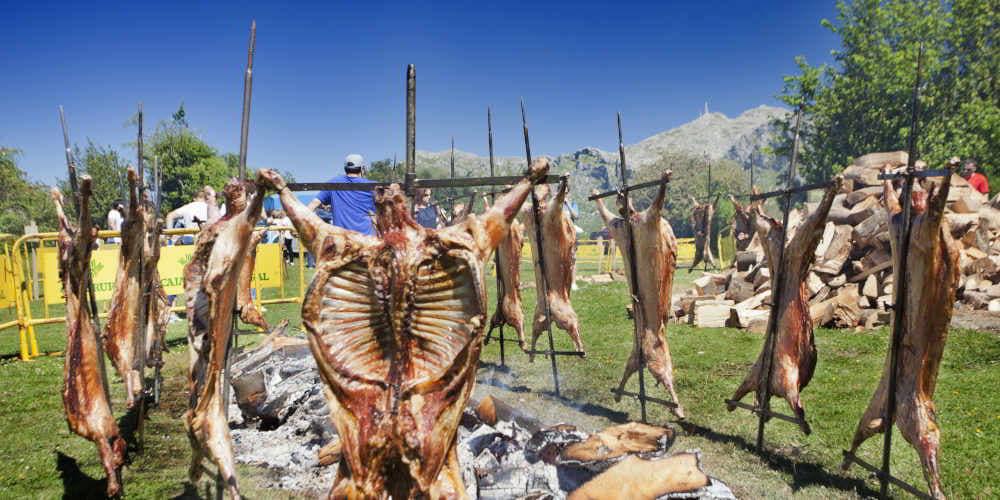
When it comes to gastronomic pleasures, the cuisine of the Central Mountains is an extension of the landscape: strong, abundant and with soul. Amongst its signature dishes, the fabada (bean stew), pote de berzas (cabbage stew), caldereta allerana (stew from Allerano) and free-range meats are outstanding. In July, in Lena, Prau Llagüezos becomes the culinary epicentre with the Fiesta del Cordero a la Estaca, a pilgrimage declared to be of Regional Tourist Interest. The mountain comes alive with pilgrims who go up on foot or by four-wheel drive, laden with cider, songs and the desire for that slow-roasted lamb.
In Morcín and Riosa, Afuega'l Pitu occupies one of the Principality's cheesemaking thrones and has a Protected Designation of Origin. It is a dairy product with character, with a thick texture and acidic flavour, which can be white or 'roxu', and comes in the form of 'trapu' or 'atroncáu', depending on whether it has been cured in cloth or mould. Its name is not misleading: 'afuega'l pitu' means 'it chokes the gullet', and those who eat it will attest to this. In La Foz de Morcín, the Museéu Etnográficu de la Llechería gives context and memory to this cheese and many others, reviewing the history of livestock and milk as an essential part of Asturian rural life.
And for dessert, panchón, a word that in itself seems chewy, dense and bread-flavoured. A relic of popular gastronomy, a traditional sweet, typical of Aller, which is made with crumbled spelt bread, and which has to be eaten with the hands.
Sleeping in this region can also be an extension of the landscape: there are those who prefer the warmth of a village house with a fireplace, those who look for a hostel in a winter season, or those who are tempted by the quiet elegance of a mansion converted into accommodation. The offer is diverse but with a common denominator: authentic hospitality and a taste of home.
The Central Mountains will never require you to make grand plans or set itineraries. Here, with a pair of boots, a bit of hunger and a great desire to get to know the area, you already have half an experience under your belt. The rest is provided by the landscape. And the people.
Images


Map
What to see
- The 10 best things to see and do in Aller
- Valgrande-Pajares and Fuentes de Invierno ski resorts.
- Las Ubiñas - La Mesa Natural Park (Biosphere Reserve), Sierra del Aramo, Coto Bello, La Cobertoria and El Angliru, Protected Landscape of Las Cuencas Mineras.
- Afuelga'l Pitu cheese competition in La Foz, Morcín.
- The village of Bueño/Güeñu.
- Mining village of Bustiello. Industrial archaeology of the Turón Valley.
- Pre-Romanesque and Romanesque architecture: Santa Cristina de Lena, San Vicente de Serrapio, Santa Eulalia de Uxo.
- Alfilorios reservoir in the councils of Morcín and Ribera de Arriba.